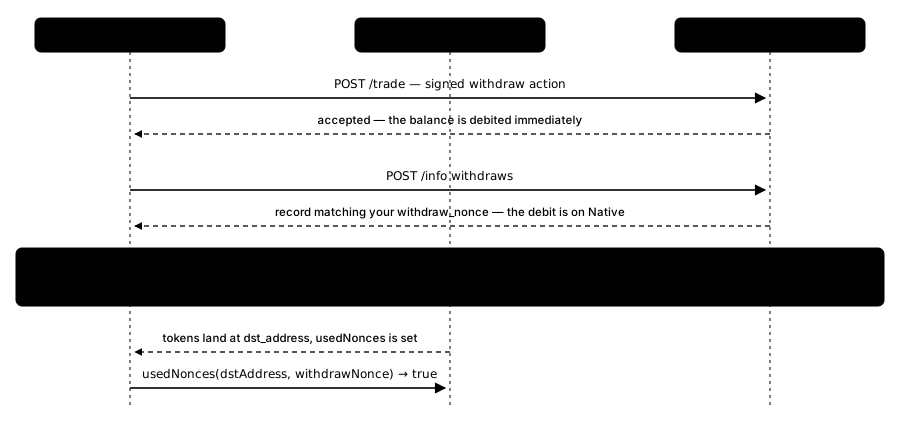
> For the complete documentation index, see [llms.txt](https://docs.native.org/native-dev/llms.txt). Markdown versions of documentation pages are available by appending `.md` to page URLs; this page is available as [Markdown](https://docs.native.org/native-dev/build-with-native/deposit-withdraw/withdraw.md).
# Withdraw
Move funds from a Native Core balance out to an EVM chain — the signed action, the amount rules, and how to confirm the payout landed.
Read [Deposit & Withdraw](/native-dev/build-with-native/deposit-withdraw.md) first for the shared endpoints, discovery queries, and rate limits.
## 1. Validate the amount
Three rules govern the amount, and a fourth number caps it. The first two come from `/info` and are enforced at admission. The third is enforced nowhere: break it and Native Core accepts the action, debits the balance, and the release is never constructed.
* **Minimum** — `min_withdraw_atoms` from the [`accountingWithdrawTokens`](/native-dev/build-with-native/native-core/reference/post-info.md#accountingwithdrawtokens) entry whose `chain_id` and `asset_id` match your destination chain and asset.
* **Fee** — `withdraw_fee_atoms` for the asset from [`assets`](/native-dev/build-with-native/native-core/reference/post-info.md#assets). It is recorded, not deducted: you sign the **gross** amount, Native debits the gross, and the destination chain releases `amount − fee`. `amount` must be strictly greater than the fee.
* **Decimal cap** — cap the amount at 6 decimal places. Native balances are 8-decimal and the release rescales into the destination token's decimals. USDT and USDC are 6-decimal on Ethereum, Arbitrum and Base, so a 6-decimal cap divides evenly into every destination token currently listed.
### The withdrawable ceiling
Each destination chain releases from its own vault. `availableWithdraw` reports what those vaults can pay out right now, per chain.
```bash
curl -sS https://api-ui.native.org/api/v3/accounting \
-H 'content-type: application/json' \
-d '{"type":"availableWithdraw","asset_id":2}'
```
```json
{
"code": 0,
"data": {
"asset_id": 2,
"balance_decimals": 8,
"available_atoms": "66411043359575",
"available": "664110.43359575",
"items": [
{ "chain_id": 1, "token_address": "0xdac17f958d2ee523a2206206994597c13d831ec7", "available_atoms": "349374163000", "available": "3493.74163" },
{ "chain_id": 56, "token_address": "0x55d398326f99059ff775485246999027b3197955", "available_atoms": "65872669196575", "available": "658726.69196575" },
{ "chain_id": 8453, "token_address": "0xfde4c96c8593536e31f229ea8f37b2ada2699bb2", "available_atoms": "100000000", "available": "1" },
{ "chain_id": 42161, "token_address": "0xfd086bc7cd5c481dcc9c85ebe478a1c0b69fcbb9", "available_atoms": "188900000000", "available": "1889" }
]
},
"message": "success"
}
```
{% hint style="warning" %}
**Check the `items` entry for your destination chain, never the top-level total.** The total is the sum of every route, and a withdrawal executes on one. Above, 664,110 USDT of headline capacity includes exactly 1 USDT on Base.
{% endhint %}
`available_atoms` is in the same 8-decimal atoms as the `amount` you sign; `available` is display only. `"0"` is a real answer. The reading is live, so take it before you sign.
`asset_id` is a JSON **number** here, unlike every other id on this page. Sending `"2"` fails with `131004`, as does any asset Native does not pay out.
## 2. Sign and submit
`withdraw` is an owner action: sign it with your main wallet under `auth_scheme: "eip712"`, never with an API wallet. The field reference is [`withdraw`](/native-dev/build-with-native/native-core/reference/post-trade.md#withdraw); the scheme is [EIP-712 signing](/native-dev/build-with-native/native-core/reference/transaction-signing.md#eip-712-signing-auth_scheme-eip712).
Use the current Unix millisecond timestamp for both `withdraw_nonce` and the envelope `nonce`, incrementing locally if two withdrawals for the same account land in the same millisecond.
Persist `withdraw_nonce` before you sign. It is the handle for the rest of this flow, on both chains.
The typed data is the common EIP-712 prefix followed by the action's own fields:
```ts
const domain = { name: 'Native Core', version: '1', verifyingContract: '0x0000000000000000000000000000000000000000' }
const types = {
Withdraw: [
{ name: 'nativeChainId', type: 'uint256' },
{ name: 'authKind', type: 'uint256' },
{ name: 'authScope', type: 'uint256' },
{ name: 'nonce', type: 'uint256' },
{ name: 'expiresAfterMsPresent', type: 'bool' },
{ name: 'expiresAfterMs', type: 'uint256' },
{ name: 'assetId', type: 'uint256' },
{ name: 'amount', type: 'uint256' },
{ name: 'dstChainId', type: 'uint256' },
{ name: 'dstAddress', type: 'address' },
{ name: 'withdrawNonce', type: 'uint256' },
{ name: 'cloidPresent', type: 'bool' },
{ name: 'cloid', type: 'bytes16' },
],
}
const withdrawNonce = BigInt(Date.now())
const message = {
nativeChainId: 696969n, // the Native chain id, not an EVM chain id
authKind: 1n,
authScope: 0n,
nonce: withdrawNonce,
expiresAfterMsPresent: false,
expiresAfterMs: 0n,
assetId: 2n,
amount: 40000000000n, // gross, 8-decimal atoms
dstChainId: 56n,
dstAddress: '0xbf381e1cbfdb0d02f3800010e490130d3dc73118',
withdrawNonce,
cloidPresent: true,
cloid: '0x22222222222222222222222222222222',
}
const signature = await wallet.signTypedData({ domain, types, primaryType: 'Withdraw', message })
```
The domain carries **no `chainId`**, so a wallet signs it while connected to any EVM chain. Post the wallet's raw 65-byte `r‖s‖v` signature verbatim.
{% hint style="info" %}
Assert the recovery locally while you build the integration. Native derives the account from the recovered signer, so typed data that does not match this definition recovers a *different* address — one with no account — and the withdrawal comes back as `OwnerDoesNotExist`, never as a signature error. A wrong struct, a stray `chainId` in the domain, and a field in the wrong order all fail this way.
```ts
import { recoverTypedDataAddress } from 'viem'
const signer = await recoverTypedDataAddress({ domain, types, primaryType: 'Withdraw', message, signature })
if (signer.toLowerCase() !== wallet.account.address.toLowerCase()) throw new Error('typed data mismatch')
```
The digest is pinned and identical across implementations, so you can also assert it directly:
```ts
hashTypedData({
domain, types, primaryType: 'Withdraw',
message: {
nativeChainId: 969696n, authKind: 1n, authScope: 0n, nonce: 99n,
expiresAfterMsPresent: true, expiresAfterMs: 1700000000000n,
assetId: 7n, amount: 1234567n, dstChainId: 56n,
dstAddress: '0x1111111111111111111111111111111111111111',
withdrawNonce: 42n, cloidPresent: true, cloid: '0x22222222222222222222222222222222',
},
})
// 0xc657633ef3dcfd2726efbabfc56d400b307a15e8c5a88d571c39367c7c527fc3
```
{% endhint %}
```bash
curl -sS -X POST "$API_URL/trade" \
-H 'content-type: application/json' \
-d '{
"action": {
"type": "withdraw",
"asset_id": "2",
"amount": "40000000000",
"dst_chain_id": "56",
"dst_address": "0xbf381e1cbfdb0d02f3800010e490130d3dc73118",
"withdraw_nonce": "1785162532020",
"cloid": "0x22222222222222222222222222222222"
},
"nonce": "1785162532020",
"auth_scheme": "eip712",
"signature": "0x…"
}'
```
Branch on `submission_status`, never on the HTTP status — `/trade` returns the same body shape for 200, 400, 429, 503 and 504.
* `accepted` — the action executed and the balance is debited.
* `rejected` — fix the `error.code` before you sign a fresh action.
* `timeout` — **not** a rejection. The withdrawal may still commit, so reconcile by `cloid` with `txStatusByCloid` instead of re-signing.
The decision playbook is [Handle outcomes & timeouts](/native-dev/build-with-native/native-core/guides/handle-timeouts.md); the code catalog is [Error Responses](/native-dev/build-with-native/native-core/reference/error-responses.md).
The authority is the recovered signer, so the debited account is whoever signed. `dst_address` is only the EVM payout target — watch it on the destination chain.
## 3. Confirm the Native debit
[`withdraws`](/native-dev/build-with-native/native-core/reference/post-info.md#withdraws) returns the executed withdrawal records for an address. Find yours by `withdraw_nonce`.
```bash
curl -sS -X POST "$API_URL/info" \
-H 'content-type: application/json' \
-d '{"type":"withdraws","user":"0xbf381e1cbfdb0d02f3800010e490130d3dc73118"}'
```
This read is a **3-day window**. It confirms the debit; it is not durable history, so record the withdrawal on your side at submit time.
Each record's `tx_hash` is the Native debit. Open it on the [Native explorer](https://app.native.org/explorer) to inspect the withdrawal by hand:
```
https://app.native.org/explorer/tx/
https://app.native.org/explorer/address/
```
## 4. Watch the destination chain
Poll `usedNonces(dstAddress, withdrawNonce)` on the destination chain until it returns `true`, on an interval that suits that chain. You never call `withdraw()` yourself — the vault rejects anything but the operator's multi-signed call.
`usedNonces` is the vault's permanent replay guard, keyed by the payout address and your `withdraw_nonce`. It flips to `true` in the same transaction that transfers the tokens, so `true` is terminal.
```solidity
function usedNonces(address user, uint256 nonce) external view returns (bool);
```
```ts
const released = await publicClient.readContract({
address: vault, abi: vaultAbi, functionName: 'usedNonces',
args: [dstAddress, withdrawNonce],
})
```
Compute the credited amount yourself: `amount − withdraw_fee_atoms`, from values you already hold.
To watch the token's `Transfer` event instead, pin the destination ERC20 addresses for the routes you support at integration time. `/info` does not map `(asset_id, chain_id)` onto an address, and symbol matching breaks on the wrapped-native routes — `ETH` is `WETH`, `BNB` is `WBNB` — and on Arbitrum `USDT`, which is `USD₮0`.
A withdrawal debited on Native that still shows `usedNonces == false` after a long wait is stalled, not lost. The release pipeline retries and never drops a debited withdrawal; the decimal cap in step 1 is the most common cause.
## What can go wrong
| Symptom | Cause | What to do |
| -------------------------------------------------- | ----------------------------------------------------------------------------- | ------------------------------------------------------------------------------------------------------------------------------- |
| `WithdrawAmountBelowMinimum` | Below `min_withdraw_atoms` for the route | Re-read `accountingWithdrawTokens` |
| `WithdrawAmountNotAboveFee` | Amount is not strictly greater than the asset's withdraw fee | Re-read `withdraw_fee_atoms` in `assets` |
| `WithdrawInsufficientBalance` | Available balance does not cover the gross amount | Re-read `userBalances`; locked balance does not count |
| `WithdrawDuplicateNonce` | `withdraw_nonce` reused, or below the 3-day pruned floor | Use a fresh millisecond timestamp |
| `ActionNotAllowedForSpotCreditAccount` | The signer is a credit account | Credit accounts cannot use this path — see [Account Types](/native-dev/build-with-native/native-core/concepts/account-types.md) |
| `OwnerDoesNotExist` for an account you know exists | The typed data does not match, so the recovered signer is a different address | Recover your own signature locally and compare it to the signing address |
| `submission_status: "timeout"` | Outcome not observed in the wait budget — it may still commit | Reconcile by `cloid`; never re-sign under a new nonce |
| Accepted, `usedNonces` stays `false` | Amount is not exactly representable in the destination token's decimals | Cap amounts at 6 decimal places; contact Native for a stalled one |
## Next steps
{% content-ref url="/pages/0XciScqbhDUPMIbRg8kC" %}
[Vault Contract](/native-dev/build-with-native/deposit-withdraw/vault-contract.md)
{% endcontent-ref %}
{% content-ref url="/pages/QkzWxm0bB3UJEjnOYrsr" %}
[Deposit](/native-dev/build-with-native/deposit-withdraw/deposit.md)
{% endcontent-ref %}