> For the complete documentation index, see [llms.txt](https://docs.native.org/native-dev/llms.txt). Markdown versions of documentation pages are available by appending `.md` to page URLs; this page is available as [Markdown](https://docs.native.org/native-dev/build-with-native/deposit-withdraw/deposit.md).
# Deposit
Move funds from an EVM chain into a Native Core balance — the vault call, the activation fee, and how to confirm the credit landed.
Read [Deposit & Withdraw](/native-dev/build-with-native/deposit-withdraw.md) first for the shared endpoints, discovery queries, and rate limits.
## 1. Check whether the account exists
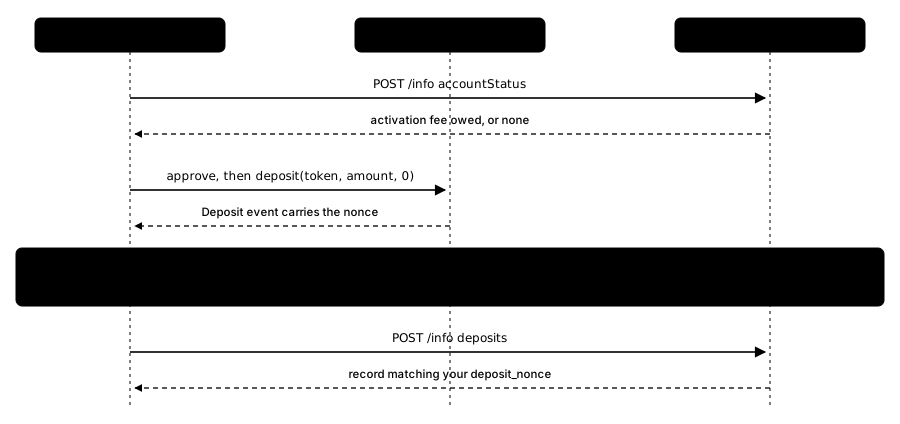
An address that has never held a Native Core balance has no account yet, and its first deposit must pay a one-time activation fee. [`accountStatus`](/native-dev/build-with-native/native-core/reference/post-info.md#accountstatus) is the authoritative signal.
The fee on this page is a **separate** charge from the one [`activateFor`](/native-dev/build-with-native/native-core/reference/post-trade.md#activatefor) takes: this one rides the deposit as `msg.value` in the source chain's gas token, that one is a fixed amount debited from an existing Native Core balance. They are two ways to reach the same result. If an account already exists — because someone called `activateFor` for the address, or because it was funded before — send `msg.value: 0`.
```bash
curl -sS -X POST "$API_URL/info" \
-H 'content-type: application/json' \
-d '{"type":"accountStatus","user":"0xbf381e1cbfdb0d02f3800010e490130d3dc73118"}'
```
```json
{ "found": true, "account_index": 6, "status": "active", "query_height": 126781073, "app_hash": "0x…" }
```
`found: true` means the account exists and the deposit carries no fee. `found: false` means this deposit will create it, and must carry the fee described next.
Treat an unreadable `accountStatus` as blocking. The vault does not enforce the fee, so a deposit sent while the answer is unknown can land on-chain and then fail validation.
## 2. Size the activation fee
The fee rides the deposit transaction as `msg.value`, in the source chain's gas token. No token allowance or second transaction is involved.
* The fee is worth **1 USD** in the chain's gas token, priced at the time the deposit is validated.
* Validation accepts a shortfall of up to **30%**, which absorbs the price movement between your quote and settlement.
* Overpayment is accepted and never refunded. Quote at your own spot price with a small buffer.
* Send `msg.value: 0` for every deposit into an account that already exists.
Price it from [`markPrices`](/native-dev/build-with-native/native-core/reference/post-info.md#markprices) — the same oracle the deposit is validated against, so your quote cannot drift out of tolerance the way an external feed can.
| Source chain | Gas token | `asset_id` |
| ------------------------ | --------- | ---------- |
| Ethereum, Base, Arbitrum | ETH | `3` |
| BNB Smart Chain | BNB | `4` |
```bash
curl -sS -X POST "$API_URL/info" \
-H 'content-type: application/json' \
-d '{"type":"markPrices"}'
```
```json
{ "mark_prices": [ { "asset_id": 3, "usd_atoms": 188483000000, "source_ts_ms": 1785222009197 } ] }
```
`usd_atoms` is a USD price in 8-decimal atoms, and the gas token is 18-decimal on all four chains, so one dollar is `10**26 / usd_atoms` wei:
```ts
const usdAtoms = BigInt(markPrices.find(p => p.asset_id === gasAssetId).usd_atoms)
const activationFeeWei = 10n ** 26n / usdAtoms
```
{% hint style="warning" %}
**Never guess the fee to zero.** Read `accountStatus` immediately before you build the transaction. A first deposit that underpays past the tolerance is permanent: the funds will not be credited.
{% endhint %}
## 3. Validate the amount
{% hint style="warning" %}
**Floor the amount to 8 decimal places, and deposit at least 10 USD.** The vault enforces neither rule. Break either one and the funds will not be credited.
{% endhint %}
**8-decimal grid.** Native credits at 8 decimals (`balance_decimals`), and settlement refuses any amount that does not convert exactly. Tokens with 8 decimals or fewer need no adjustment: WBTC, cbBTC, and USDC/USDT on Ethereum, Base and Arbitrum cannot carry excess precision.
```ts
const scale = 10n ** BigInt(Math.max(0, decimals - 8)) // 10^10 for an 18-decimal token
const amount = requested - (requested % scale)
```
`minDepositDecimalByUnderlying(token)` returns the grid (`8` on every listed token).
**10 USD minimum.** The floor is a fixed amount of the deposited token, set per chain and token, not a conversion from the current price. On a stablecoin it is 10 tokens. On a volatile token, quote above 10 USD rather than exactly at it: a rise in that token's price lifts the floor above what 10 USD buys.
## 4. Approve and deposit
`deposit()` pulls the ERC20 from the caller, so it needs an allowance first. Amounts are in the token's own decimals.
```solidity
function deposit(address token, uint256 amount, uint256 actionFlag)
external payable returns (uint256 wNLPAmount);
```
Pass `actionFlag: 0` — the standard deposit path.
```ts
import { createPublicClient, createWalletClient, http, erc20Abi, parseUnits } from 'viem'
import { bsc } from 'viem/chains'
import { vaultAbi } from './vaultAbi'
const publicClient = createPublicClient({ chain: bsc, transport: http(RPC_URL) })
const wallet = createWalletClient({ chain: bsc, transport: http(RPC_URL), account })
const requested = parseUnits('100', 18) // BSC USDT is 18-decimal
const amount = requested - (requested % 10n ** 10n) // floor to the 8-decimal grid
const feeWei = accountExists ? 0n : activationFeeWei
const [vaultPaused, tokenPaused] = await Promise.all([
publicClient.readContract({ address: vault, abi: vaultAbi, functionName: 'emergencyPaused' }),
publicClient.readContract({ address: vault, abi: vaultAbi, functionName: 'isDepositPaused', args: [token] }),
])
if (vaultPaused || tokenPaused) throw new Error('deposits are paused')
const approveHash = await wallet.writeContract({
address: token, abi: erc20Abi, functionName: 'approve', args: [vault, amount],
})
await publicClient.waitForTransactionReceipt({ hash: approveHash })
const depositHash = await wallet.writeContract({
address: vault, abi: vaultAbi, functionName: 'deposit',
args: [token, amount, 0n], value: feeWei,
})
const receipt = await publicClient.waitForTransactionReceipt({ hash: depositHash })
```
Read both pause flags before you build the transaction, so the user sees a reason instead of a revert. `isDepositPaused(token)` covers a single token, `emergencyPaused()` the whole vault. Pause is the only amount-independent condition the vault itself gates.
To fund an address other than the caller — a wallet or aggregator depositing on a user's behalf — use `depositFor`, which credits `user` instead of `msg.sender`:
```solidity
function depositFor(address token, uint256 amount, address user, uint256 actionFlag)
external payable returns (uint256 wNLPAmount);
```
The activation fee follows the credited address, not the caller: read `accountStatus` for `user`.
## 5. Read the deposit nonce from the receipt
The vault assigns each deposit a sequential `nonce` and emits it in the `Deposit` event. That nonce is how Native Core identifies the deposit, and the only handle that survives into the credit record.
```ts
import { decodeEventLog } from 'viem'
const log = receipt.logs.find(l => l.address.toLowerCase() === vault.toLowerCase())
const { args } = decodeEventLog({ abi: vaultAbi, data: log.data, topics: log.topics })
const depositNonce = args.nonce // e.g. 31n
```
## 6. Wait for the credit
Poll [`deposits`](/native-dev/build-with-native/native-core/reference/post-info.md#deposits) and match on the tuple `(src_chain_id, src_contract, deposit_nonce)`. Do not sleep on a fixed timer.
The credit lands **about 5 minutes** after the deposit transaction, a typical latency rather than a guarantee, because settlement waits for the source transaction to be safely confirmed. Nothing is submitted to Native in the meantime, and closing your process after the deposit transaction lands does not affect the credit.
```bash
curl -sS -X POST "$API_URL/info" \
-H 'content-type: application/json' \
-d '{"type":"deposits","user":"0xbf381e1cbfdb0d02f3800010e490130d3dc73118"}'
```
```json
{
"deposits": [
{
"tx_hash": "0x2dd46662ecc762d70291e9475e50890ffb4c79c85e61c539f1e138a8b71b82a7",
"block_height": 125866793,
"block_timestamp_ms": 1785157736296,
"asset_id": 44,
"amount_atoms": "7050704",
"src_chain_id": 56,
"src_contract": "0xd7afd8fbecc1ae7a4ce5b93eb59d76f967d0dea7",
"deposit_nonce": "30"
}
],
"user": "0xbf381e1cbfdb0d02f3800010e490130d3dc73118"
}
```
A matching record means the balance is credited and tradable.
* `asset_id` — which Native asset the ERC20 mapped to, so you never need a token-to-asset table of your own.
* `amount_atoms` — the credited amount in that asset's `balance_decimals` (8), rescaled from the token's own decimals. The on-chain `70507040000000000` at 18 decimals arrives as `7050704` at 8.
* `tx_hash`, `block_height` — Native Core, not the source chain.
[`userBalances`](/native-dev/build-with-native/native-core/reference/post-info.md#userbalances) is the settled-state read once the deposit is done.
Open the credit on the [Native explorer](https://app.native.org/explorer) to inspect it by hand:
```
https://app.native.org/explorer/tx/
https://app.native.org/explorer/address/
```
## What can go wrong
| Symptom | Cause | What to do |
| --------------------------------------------- | -------------------------------------------------------------------------------------------------------------------------------------------------------------------------------------- | ------------------------------------------------------------------------------- |
| `deposit()` reverts `UnsupportedUnderlying` | Token is not listed on this vault | Read `getSupportedUnderlyings()` before submitting |
| `deposit()` reverts with no data to decode | Allowance or balance too low — most ERC20s revert here without a reason string, so nothing decodes | Re-check the allowance you set in step 4 |
| Mined, still no credit well past 5 minutes | Amount was below the 10 USD minimum, was not on the 8-decimal grid, or a first deposit underpaid the activation fee — read `getDepositRecord(nonce)` and check `amount` and `msgValue` | None of the three is self-recoverable — contact Native with the source tx hash |
| Mined, no credit yet, account already existed | Still inside the normal settlement delay | Keep polling; report a credit that has not landed well past 5 minutes |
| `429` with `RateLimited` | More than 1 `/info` request per second from one IP | Wait the `retry after` interval in the error, and share one budget across loops |
## Next steps
{% content-ref url="/pages/9c636P5KhDpLoHJwE9oC" %}
[Withdraw](/native-dev/build-with-native/deposit-withdraw/withdraw.md)
{% endcontent-ref %}
{% content-ref url="/pages/0XciScqbhDUPMIbRg8kC" %}
[Vault Contract](/native-dev/build-with-native/deposit-withdraw/vault-contract.md)
{% endcontent-ref %}